Welcome to the official website of GSE Tech (Suzhou) Co., Ltd.!
Service hotline:+86 512 65111668

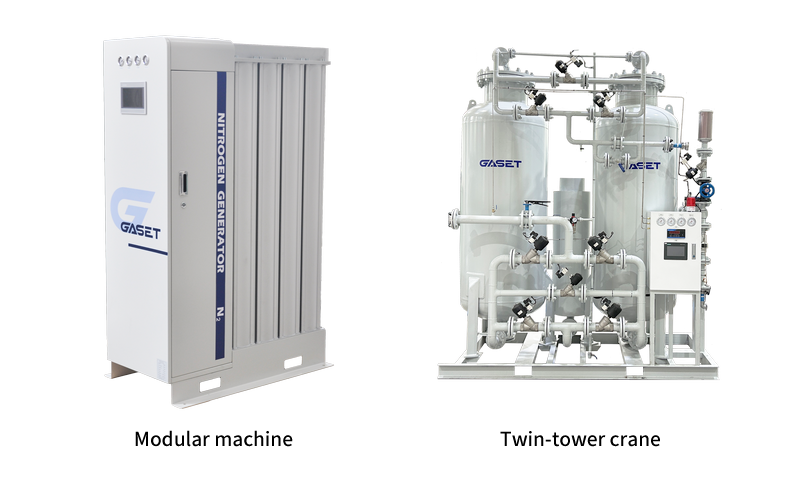
Performance comparison between modular nitrogen generator and twin tower nitrogen generator

Release time:2019-07-25   Number of views:1110

Comparative dimension

Modular nitrogen generator

Twin tower nitrogen generator

Design and Principles

Multiple independent adsorption units (modules) working in parallel

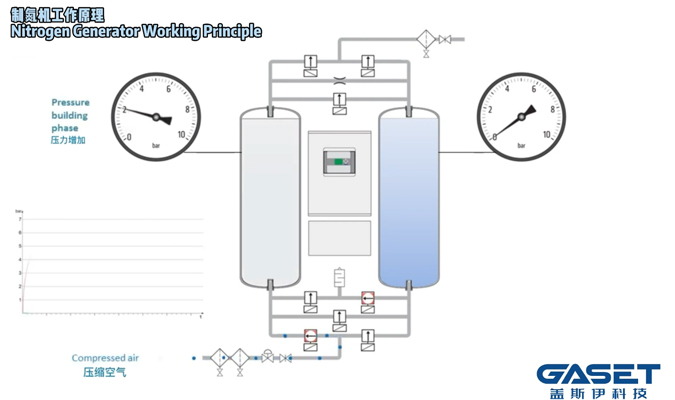
Two adsorption towers alternate between adsorption and regeneration

Purity and flow rate

Purity can reach over 99.999%

Purity can reach over 99.99%

Flexibility

High. Capacity can be adjusted by adding or removing modules

Low. Fixed structure, complex capacity adjustment

Energy efficiency

High. Using efficient molecular sieves, the air to nitrogen ratio can reach 4.2:1, with low energy consumption

It depends on the operating conditions. High energy efficiency during full load operation, but energy consumption increases during low load or frequent start stop operations

Maintenance cost

Low. Module independence, quick replacement, short downtime

Relatively high. The valve control system is complex and requires professional personnel for maintenance, which may result in long downtime

Floor area

Small. Compact structure, modular design

Big. Two adsorption towers and supporting pipelines are required


How to choose: Focus on core needs
After understanding the basic differences, you can determine which type is more suitable based on your core needs.

Choose a modular nitrogen generator, if:
Production needs to be flexible: there are clear expansion plans in the future, or there are seasonal and cyclical fluctuations in production itself.
Space and energy efficiency are key: limited factory space or strict control requirements for production energy consumption.
Initial budget limited: I hope to control the initial investment cost and pursue lower maintenance costs.

Choose a twin tower nitrogen generator if:
Pursuing extremely high nitrogen purity: Your production process, such as in semiconductor chip manufacturing or certain precision chemical fields, requires nitrogen purity of 99.999% or above.
Large and stable demand: Your production line requires a large-scale, continuous, and stable supply of nitrogen, with long-term stable gas usage.
Emphasis on long-term stability: Under full load continuous operation conditions, its stability and economic performance are better.
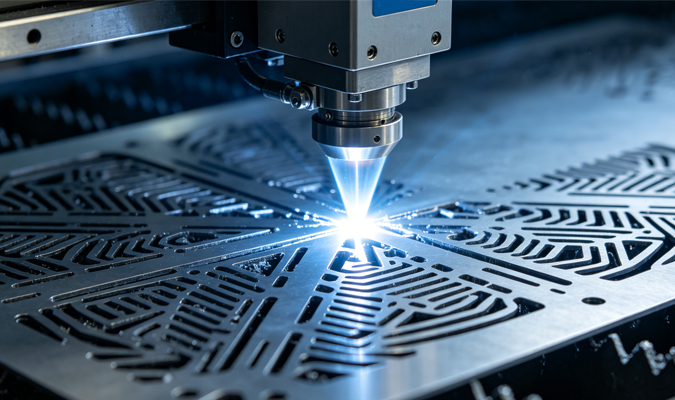
Application of nitrogen in laser cutting

Laser cutting uses nitrogen to solve many processing problems in actual production, and expands the processing range to the fields where oxygen cutting is difficult to process, such as aluminum and brass. The following describes its applications in various materials and fields.
1. carbon steel
Carbon steel is cut with oxygen. The surface temperature is very high due to carbon assisted melting and oxygen combustion. When cutting holes with sharp corners and diameters smaller than the material thickness, too much heat is concentrated in the narrow area, so that the cutting quality cannot be guaranteed. Nitrogen does not assist in combustion and has a cooling effect, which is suitable for solving such processing problems and can improve product quality.
2. stainless steel
In consideration of cost, the oxidation of cutting edge does not affect the use of stainless steel parts. Oxygen cutting is used. However, the content of alloy elements such as Ni in stainless steel is large, the viscosity of melt is large, and the fluidity is poor. The low air pressure during oxygen cutting is easy to lead to quality defects such as slag sticking. When welding stainless steel, the oxidation layer seriously affects the welding quality, especially argon arc welding. Nitrogen cutting provides high-quality non oxidation section, which meets the high requirements of stainless steel welding for cutting section.
3. aluminum and brass
Aluminum and brass have high reflectivity and low absorptivity to laser, which requires high power to melt materials. In addition, it shall be equipped with a reflection and absorption device so that the uneven linear wave will not be reflected back to the lens to protect the safety of the laser. Nitrogen cutting is required.
The melting point of aluminum is low. Oxygen can be used to cut aluminum with thickness less than 3mm, but the quality is very poor, and the section has hard burrs. The nitrogen cutting section is smooth, and the effect of no burr can be obtained if the thickness is less than 4mm. Due to the high viscosity and thermal conductivity of aluminum, the melt may have cooled before blowing away, so burrs are easy to appear. Reduce the surface roughness value by adjusting the focus, increasing the air pressure and reducing the speed, so as to ensure that the burr can be easily removed.
4. etching
Etching is a kind of special cutting, and the energy is only 5% of the basic power. It only acts on the surface of the material and is mainly used for etching marks. The oxygen etching temperature is high, and sometimes there is welding slag on the surface. Concentrated etching can also damage the surface of parts due to heat concentration. Nitrogen etching is bright and does not damage the surface. It can be used to etch instructions with high requirements.
Oxygen cutting has large thickness and low cost. It is mainly used in carbon steel. The cooling and protection of nitrogen improves the cutting quality, and has achieved good results in cutting stainless steel, aluminum and brass, and solved many processing problems.
In addition, it can be used to process wood, plexiglass and other special materials without auxiliary combustion, which has a broad application prospect.


GSE Tech(Suzhou)Co.,Ltd.
MB:+86 512 65111668
E-mail:ziyi.ying@gsetech.cn
Add:Building13-1,No.58,Sunshine Avenue,Changshu City,Jiangsu Province

View details >>
12
30
Key technical equipment in the 3D printing industry
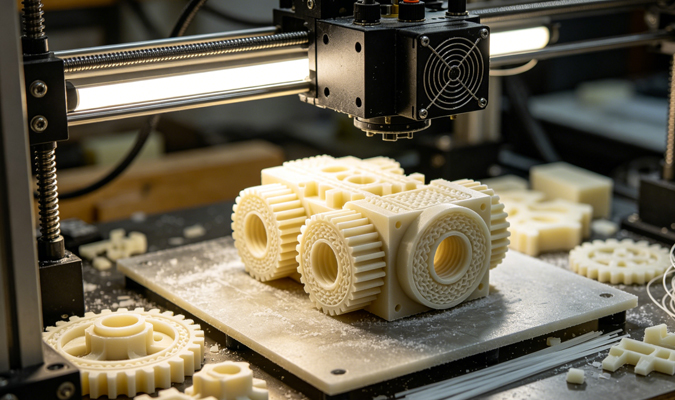
With the widespread application of 3D printing technology in aerospace, medical dentistry, automotive manufacturing and other fields, a modular and efficient nitrogen production equipment is quietly becoming an important driving force for the high-quality development of the industry.
In the rapidly developing field of 3D printing today, the oxidation protection of metal powder during laser melting directly affects product quality and performance.

Traditional nitrogen supply methods such as steel cylinders and canned liquid nitrogen are gradually being replaced by a more efficient and economical technology - modular nitrogen generators, which use pressure swing adsorption (PSA) technology to directly separate nitrogen of the required purity from the air, providing an unprecedented gas solution for 3D printing.

Inert gas protection requirements for 3D printing
In metal 3D printing processes such as selective laser melting (SLM), metal powders are prone to oxidation at high temperatures, leading to defects or even failure of the finished product.
The high-purity inert gas environment surrounding the metal powder bed of the 3D printer is key to ensuring printing quality, as it can effectively prevent metal oxidation during laser melting.
Nitrogen, as an ideal protective gas, plays multiple roles in the 3D printing process: preventing oxidation of printing materials at high temperatures, cooling the print head to reduce heat accumulation, improving printing accuracy, and ultimately enhancing product quality.
For different printing materials, the required inert gases also vary - argon is used for steel and titanium, while nitrogen is suitable for printing aluminum.
Technical principle of modular nitrogen generator
The modular nitrogen generator adopts pressure swing adsorption (PSA) technology to directly separate nitrogen from the air. 78% of the air is nitrogen, which means the nitrogen generator will never stop producing nitrogen according to demand. This technology utilizes carbon molecular sieves (CMS) as adsorbents to separate air and produce high-purity nitrogen gas at room temperature, with a stable purity of up to 99.999%.
Modular design allows users to flexibly expand their nitrogen production capacity according to actual needs, simply adding CMS modules to increase gas production. This feature is particularly suitable for 3D printing enterprises with continuously expanding production scales.
Advantages of modular nitrogen generator
Compared with traditional gas supply methods, modular nitrogen generators have shown significant advantages in the field of 3D printing. It can generate nitrogen in real time, avoiding nitrogen storage and transportation, greatly improving production efficiency. In terms of cost, the modular nitrogen generator has both low purchase and operating costs. Compared with traditional nitrogen supply methods, it can significantly reduce the procurement and transportation costs of nitrogen. High quality components ensure uninterrupted supply of nitrogen 24/7, meeting the needs of continuous operation in industrial production. The modular nitrogen generator has a compact structure, making it easy to connect to existing compressed air systems and plug and play, greatly improving the usability of the equipment.
Market prospects and development trends
According to market research reports, the 3D printing gas market is maintaining stable growth, with nitrogen being an important component.
Modularization, intelligence, and energy efficiency have become the main directions for the development of nitrogen generator technology. The latest generation of nitrogen generators is equipped with features such as purity monitoring, optional fail safe shutdown, and environmental protection mode, maximizing energy efficiency and reducing operating costs. With the penetration of 3D printing technology into more industries, the demand for efficient and economical gas solutions will continue to grow, and modular nitrogen generators are expected to become the standard configuration for more 3D printing enterprises.
View details >>
09
22
LINKS
CONTACT
  • Service hotline:+86 512 65111668
  • Mobile&WeChat:+86 13328023569
  • Mailbox:ziyi.ying@gsetech.cn
  • ADD:Building 13-1, No. 58 Sunshine Avenue, Changshu City, Jiangsu Province  
FOLLOW US
Follow us
Follow us